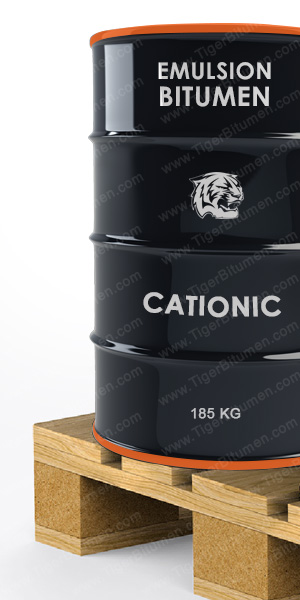
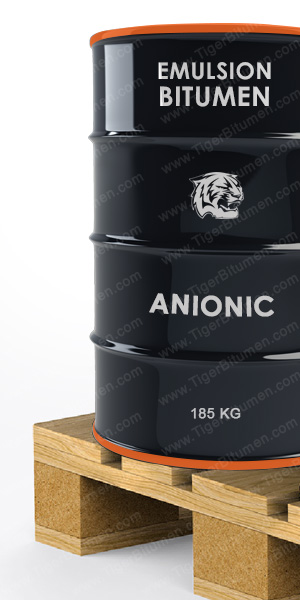
Turkey Bitumen, a Turkey-focused international supply portal of Tiger Bitumen operated by HY International Group, supplies Cationic and Anionic Emulsion Bitumen to international buyers, including contractors, distributors, and infrastructure developers sourcing material for road construction and pavement maintenance projects connected with Turkey. Our emulsion bitumen is used across road construction, tack coats, prime coats, slurry seals, surface dressing, and cold mix asphalt applications, supplied as genuine physical merchandise rather than resold cargo.
This page explains what emulsion bitumen is, the difference between cationic and anionic emulsions, how emulsions are classified by setting speed, their applications and advantages, and how international buyers can request specifications or a quotation.
Emulsion bitumen is a bituminous binder produced by dispersing bitumen as microscopic droplets in water, stabilized with specialized emulsifying agents that keep the droplets suspended rather than coalescing back into bulk bitumen. This gives the product genuine storage stability it can be stored and handled as a liquid until it’s needed on site.
Because the bitumen is carried in water rather than requiring the material to be heated to a fluid state, emulsion bitumen can be applied at much lower temperatures than conventional hot bitumen, in many cases without high-temperature heating at all. This reduces energy consumption on site, improves workplace safety by removing much of the hot material handling involved with neat bitumen, and simplifies application equipment and logistics. Once applied, the emulsion “breaks” the water separates out and evaporates, and the bitumen droplets coalesce and bond to the aggregate or pavement surface, providing the adhesion and durability expected of a bituminous binder.
Emulsion bitumen is manufactured in two major types, distinguished by the electrical charge carried by the suspended bitumen droplets: Cationic Bitumen Emulsion and Anionic Bitumen Emulsion. This charge affects how the emulsion interacts with the aggregate it’s applied to, which is why the correct type needs to be matched to the aggregate and application rather than treated as interchangeable.
Our confirmed emulsion range reflects this distinction directly in its grade naming. Cationic grades are supplied as Cationic Rapid Setting (CRS-1, CRS-1H, CRS-2), Cationic Medium Setting (CMS-2), and Cationic Slow Setting (CSS-1, CSS-1H). Anionic grades are supplied as Rapid Setting (RS-1, RS-1H, RS-2), Medium Setting (MS-1, MS-2, MS-4, MS-5), and Slow Setting (SS-1, SS-1H). We also supply a dedicated tack coat line (K1-30, K1-40, K1-60, K1-70) for tack coat applications specifically.
Buyers should confirm with their project specification or engineering consultant which type cationic or anionic is called for, since this depends on the aggregate mineralogy and construction method involved, and our export team can help match your requirement to the correct grade.
Beyond the cationic/anionic distinction, emulsion bitumen is classified according to how quickly it breaks separates and sets after coming into contact with aggregate. Selecting the correct setting classification depends on the construction method and the aggregate’s surface area and fines content.
Rapid-setting emulsion breaks quickly, even with coarse aggregate that has relatively low surface area. It’s subdivided into RS-1 and RS-2 grades. RS emulsion is commonly used for surface dressing, spray applications, and road maintenance work where quick setting is required to minimize the time before traffic can return to the surface.
Medium-setting emulsion breaks slowly enough to be mixed with coarse aggregate containing a higher proportion of fine material, giving contractors working time before the emulsion sets. MS emulsion grades include MS-1, MS-2, MS-4, and MS-5, and they are well suited to premix works and general mixing with coarse aggregates that include fine material.
Slow Setting emulsion breaks slowly enough to be mixed with aggregate containing fine material of relatively high surface area, giving the longest working time of the three classifications. It’s subdivided into SS-1 and SS-2 grades, and is suited to slurry seal, cold mix asphalt, soil stabilization, and other applications where extended mixing time is required.
Emulsion bitumen is used across a range of road construction and pavement maintenance applications, with the appropriate type and setting classification selected according to the construction method, aggregate characteristics, and project specification:
Buyers sourcing emulsion bitumen for infrastructure work connected with Turkey typically require RS or CRS grades for surface dressing and maintenance work, MS/CMS or SS/CSS grades for premix and cold mix production, and K1-series tack coats for layer bonding during new construction. The right selection depends on your specific project requirements. Confirm the required type and grade with your engineering specification before ordering.
Emulsion bitumen offers several practical advantages over conventional hot-applied bitumen for suitable applications:
These advantages make emulsion bitumen a practical choice for maintenance-focused work and any project where minimizing on-site heating and energy use is a priority, though the correct grade must still be matched to the application for reliable performance.
Emulsion bitumen is supplied in export packaging suited to project requirements, with batch testing carried out before dispatch to support consistent product quality. SGS inspection is available upon request. Buyers who want independent third-party verification before loading can request SGS inspection, appoint their own inspection agency, or arrange to have a representative attend loading in person.
Tiger Bitumen supplies international buyers sourcing emulsion bitumen for road construction and infrastructure projects connected with Turkey, including contractors, distributors, and asphalt or construction companies working on pavement maintenance and new construction. We supply as an international exporter. Our production and packing facilities are in the Karachi Free Zone, Pakistan, and Ajman Port, UAE, not in Turkey. We coordinate export logistics to Turkey and other international destinations on FOB, CFR, or CIF terms depending on the buyer’s requirements.
HY International has the capability to Export and Supply the different Grades of Coat Bitumen in compliance with National and International standards.
Emulsion bitumen is bitumen dispersed as microscopic droplets in water, stabilized with emulsifying agents. It can be applied at lower temperatures than conventional hot bitumen, with the water evaporating after application so the bitumen bonds to the aggregate or pavement surface.
The two types differ by the electrical charge on the suspended bitumen droplets, which affects how the emulsion interacts with aggregate. The correct type depends on the aggregate mineralogy and project specification cationic grades are typically supplied as CRS/CMS/CSS, anionic grades as RS/MS/SS.
RS emulsion breaks quickly after contact with aggregate, even coarse aggregate with low surface area, making it suited to surface dressing, spray applications, and maintenance work requiring fast setting.
RS-1 and RS-2 are the two grades within the Rapid Setting classification, differing in viscosity and bitumen content. Confirm which grade your project specification calls for with our export team.
MS emulsion breaks slowly enough to be mixed with coarse aggregate containing a higher proportion of fine material, making it suited to premix works.
SS emulsion breaks slowly enough to mix with fine, high-surface-area aggregate, giving extended working time. It's used for slurry seal, cold mix asphalt, and soil stabilization.
SS-1 and SS-2 are the two grades within the Slow Setting classification. As with RS-1/RS-2, the correct grade depends on your project's aggregate and application confirm with our export team.
Across surface dressing, tack coats, prime coats, slurry seals, cold mix asphalt, premix works, soil stabilization, and general road maintenance and pavement rehabilitation.
Lower application temperatures, reduced energy consumption, improved workplace safety, easier application, and reliable storage stability, while still providing strong adhesion once the emulsion has broken.
Yes. We supply international buyers, including those sourcing emulsion bitumen for road construction and pavement maintenance projects connected with Turkey. Send us your required type, classification, quantity, and destination details and our export team will respond directly.
If you’re sourcing emulsion bitumen for a road construction or pavement maintenance project connected with Turkey or any other market tell us your required emulsion type (cationic or anionic), classification and grade, quantity, packaging requirement, destination port, and project or application details. Our export team will respond with technical specifications, current pricing, and a firm quotation.
Visit: www.TigerBitumen.com