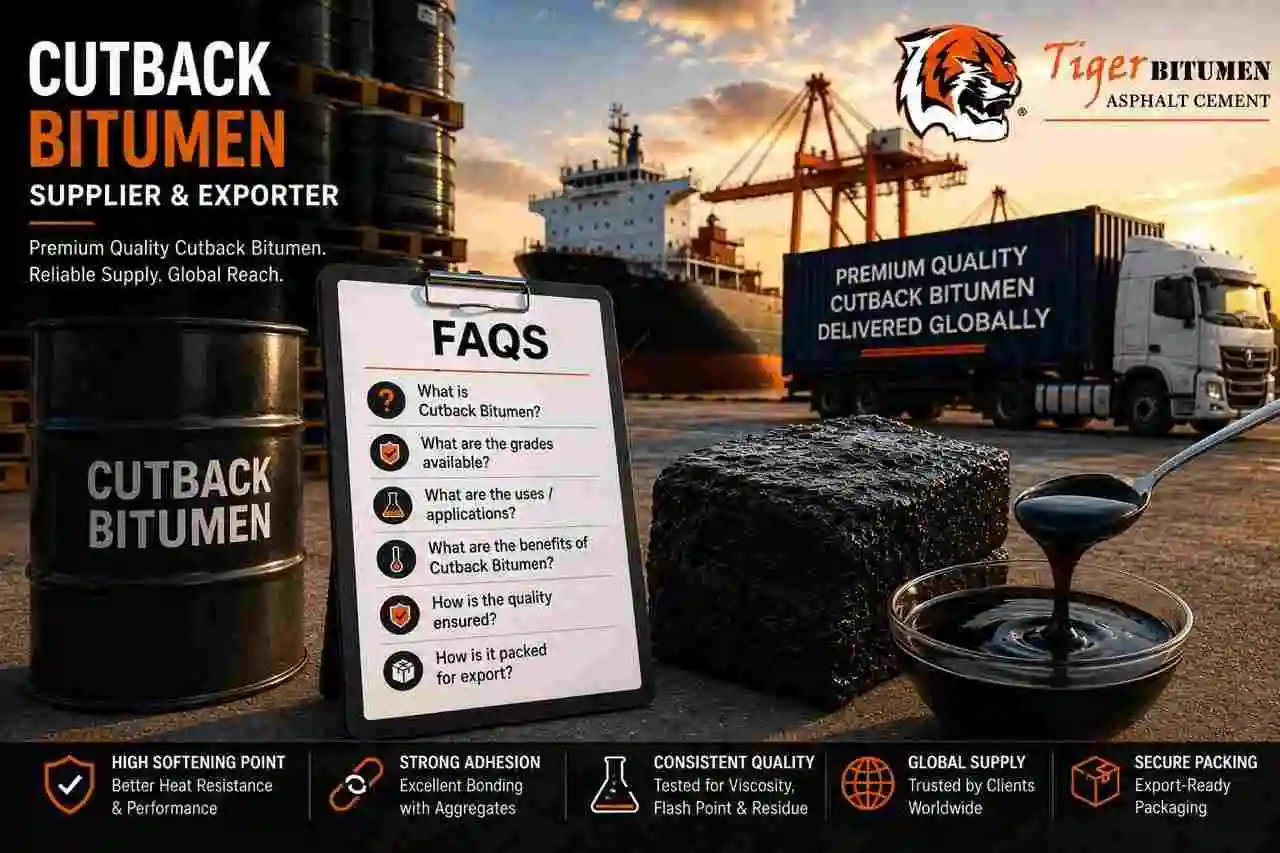
Tiger Bitumen, the international bitumen brand of HY International Group, is a cutback bitumen supplier and exporter, supplying Rapid Curing (RC), Medium Curing (MC), and Slow Curing (SC) grades to buyers around the world, including contractors, importers, distributors, and infrastructure developers sourcing material for road construction and maintenance projects connected with Turkey. Our cutback bitumen is manufactured from Penetration Grade Bitumen blended with selected petroleum solvents, and is widely used for prime coats, tack coats, cold mix asphalt, surface dressing, and pavement patching and maintenance.
This page explains what cutback bitumen is, how it differs from Bitumen Emulsion, how it’s manufactured, its RC/MC/SC classifications and grades, applications, packaging, export documentation, and how international buyers can request a quotation.
Cutback bitumen is penetration grade bitumen that has been blended with a petroleum solvent typically naphtha, kerosene, gasoline, or white spirit to temporarily reduce its viscosity. This makes it fluid enough to penetrate pavement surfaces more effectively, or to be sprayed at temperatures too cold for successful sealing with neat, unmodified bitumen.
Once applied, the solvent evaporates, leaving behind a bitumen layer with hardness and adhesion properties similar to the original penetration grade bitumen it was made from. The type of solvent used controls how quickly the cutback cures, while the amount of solvent added determines its viscosity which is the basis for how cutback bitumen is classified and graded.
Cutback bitumen is produced by blending selected penetration-grade bitumen with a petroleum solvent under controlled conditions. The choice of solvent determines the curing rate: highly volatile solvents evaporate quickly, giving a fast-curing product, while less volatile solvents evaporate slowly, extending workability. The proportion of solvent blended in determines the finished viscosity of the cutback.
Each production batch is tested to verify viscosity, flash point, and residue characteristics before it’s approved for shipment, confirming the batch meets its stated classification and grade rather than simply falling close to it.
Cutback bitumen and bitumen emulsion are both used to temporarily reduce bitumen’s viscosity for easier application, but they achieve this in fundamentally different ways.
Cutback bitumen is produced by dissolving penetration grade bitumen in a petroleum solvent. The finished layer forms once the solvent evaporates. Bitumen emulsion, by contrast, is produced by dispersing bitumen in water with the help of emulsifying agents; the bitumen bonds to the aggregate as the water evaporates, rather than a solvent. Because it relies on water rather than a petroleum solvent, bitumen emulsion generally contains lower levels of volatile organic compounds (VOCs), which makes it the preferred choice where environmental or VOC considerations are a priority.
Cutback bitumen tends to offer better penetration into road surfaces, making it well suited to prime coats, surface dressing, patching, and cold weather construction, where you need the material to actively soak into the substrate. Bitumen emulsion is more commonly used for tack coats, slurry seals, micro surfacing, and maintenance work where heating isn’t required. Which product is right for a given project depends on the specification, climate, and construction method involved. Buyers unsure which to specify should confirm the requirement with their project’s engineering documentation before ordering.
Cutback bitumen is classified according to the volatility of the solvent used in manufacturing. There are three classifications Rapid Curing, Medium Curing, and Slow Curing each suited to different construction requirements.
Rapid Curing (RC)
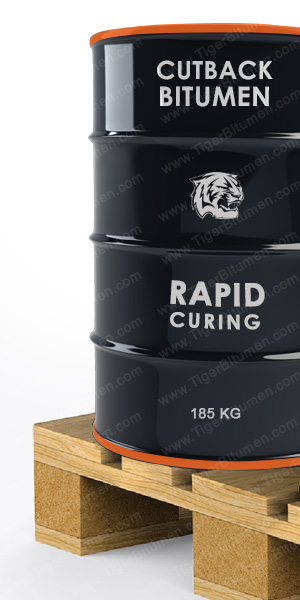
Rapid Curing cutback bitumen is made with highly volatile solvents that evaporate quickly after application. It’s primarily used for spray applications, surface dressing, and projects where fast curing and early traffic opening are priorities.
Medium Curing (MC)
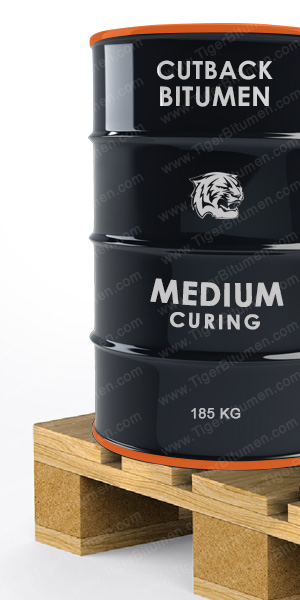
Medium Curing cutback bitumen uses solvents of medium volatility, giving a balanced curing rate with strong workability. It’s widely used for prime coats, cold mix asphalt, patching, and general road maintenance work.
Slow Curing (SC)
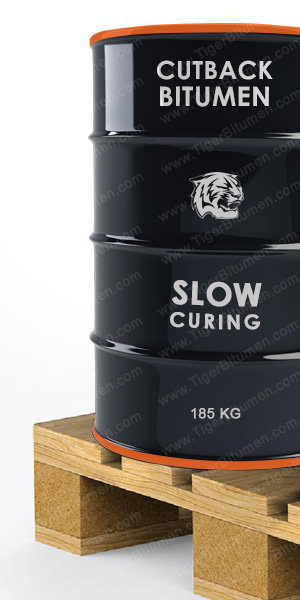
Slow Curing cutback bitumen uses low-volatility solvents that evaporate gradually, allowing deeper penetration into aggregates. It’s suited to soil stabilization, dust control, stockpile mixes, and projects that require extended workability before curing.
Within each classification, grades are further defined by a number indicating the minimum kinematic viscosity of the cutback the higher the number, the more viscous the material. Tiger Bitumen’s confirmed range covers RC, MC, and SC grades at viscosity levels of 30, 70, 250, 800, and 3000 across the respective classifications, giving specifiers a wide range to match project and climate requirements.
HY International has the capability to Manufacturer the different Grades of Cutback Bitumen in compliance with National and International standards.
Cutback bitumen is engineered to give contractors a workable, penetrating binder for applications where neat bitumen would be too viscous to apply effectively. Depending on the classification and grade selected, buyers can expect:
Selecting the correct classification and grade for a project’s timeline and climate rather than defaulting to whichever is easiest to source determines how well the cutback performs during construction and how quickly the pavement can be opened to traffic.
Cutback bitumen is used across a range of road construction and maintenance applications where its penetrating, sprayable properties are an advantage over neat bitumen:
Buyers sourcing cutback bitumen for infrastructure work connected with Turkey typically require it for exactly these applications prime and tack coating during new road construction, and patching or resealing work on existing pavement networks.
Tiger Bitumen supplies all three cutback bitumen classifications, each available across multiple viscosity grades:
Rapid Curing (RC): RC-30, RC-70, RC-250, RC-800, RC-3000
Medium Curing (MC): MC-30, MC-70, MC-250, MC-800, MC-3000
Slow Curing (SC): SC-30, SC-70, SC-250, SC-800, SC-3000
Individual grade specification pages are available for review, including:
For grades not linked directly above, or to confirm current availability and packaging for any classification, contact our export team with your specification.
Cutback bitumen can be supplied in new 185 kg steel drums or bulk shipment, depending on project size and shipping requirements. Every production batch is tested before dispatch to verify viscosity, flash point, and residue characteristics, and SGS inspection is available upon request. Buyers who want independent third-party verification before loading can request SGS inspection, appoint their own inspection agency, or arrange to have a representative attend loading in person.
We supply on FOB, CFR, or CIF terms, depending on the buyer’s preferred commercial arrangement and destination port. Each export shipment is accompanied by a standard documentation package:
Buyers coordinating import procedures into Turkey, or any other destination, should confirm their own local documentation and customs requirements in advance, as these vary by port and by the buyer’s import classification. Because cutback bitumen contains volatile petroleum solvents, some destinations apply specific handling or import classifications to it buyers should confirm any such requirements with their own customs broker ahead of shipment.
Tiger Bitumen is committed to supplying cutback bitumen backed by genuine production capability, tested documentation, and dependable export logistics. Specifically:
Cutback bitumen is penetration-grade bitumen blended with a petroleum solvent to temporarily reduce its viscosity, making it easier to apply or spray. The solvent evaporates after application, leaving a bitumen layer similar in hardness to the original grade.
The classifications reflect the volatility of the solvent used. RC (Rapid Curing) uses highly volatile solvent and cures quickly, suited to spray applications and surface dressing. MC (Medium Curing) balances curing speed and workability, suited to prime coats and cold mix asphalt. SC (Slow Curing) uses low volatility solvent for gradual curing and deeper aggregate penetration, suited to soil stabilization and stockpile mixes.
Cutback bitumen uses a petroleum solvent that evaporates after application. Bitumen emulsion disperses bitumen in water using emulsifying agents, and the water evaporates instead. Emulsion generally has lower VOC content and doesn't require heating, while cutback offers better penetration into pavement surfaces.
MC grades are commonly used for prime coats due to their balanced curing rate and workability. Confirm the specific MC grade against your project's specification and climate conditions, or ask our export team for guidance.
Yes. We supply international buyers, including those sourcing cutback bitumen for road construction and maintenance projects connected with Turkey. Send us your required classification, grade, quantity, and destination details and our export team will respond directly.
New 185 kg steel drums or bulk shipment, depending on your project size and shipping requirements.
Yes, SGS inspection is available upon request. Buyers can also appoint their own inspection agency or attend loading directly.
A Certificate of Analysis, Material Safety Data Sheet, commercial invoice, and packing list are provided as standard, with a Certificate of Origin and SGS inspection report available on request.
Yes. We quote against whichever commercial term suits the buyer's logistics arrangement and destination port.
Send us your required classification (RC, MC, or SC), grade, quantity, packaging preference, and destination port, along with your preferred FOB, CFR, or CIF term, and our export team will respond with technical documentation and a firm quotation.
If you’re sourcing cutback bitumen for a road construction or maintenance project connected with Turkey or any other market tell us your required classification, grade, quantity, and destination port. Our export team will respond with technical specifications, documentation details, and a firm FOB, CFR, or CIF quotation.
Visit: www.TigerBitumen.com